
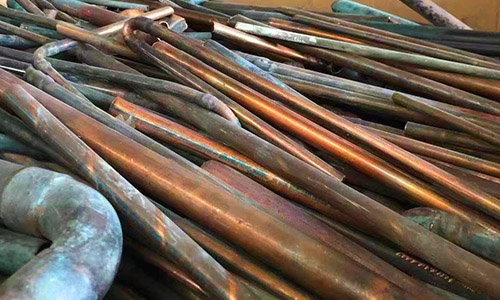
Copper ingot is fabricated into sheet, strip, foil, tube, bar, profile and wire by metal plastic deformation method. The main processing methods are rolling, extrusion and stretching, plus forging, deep drawing, spinning and other processes.
Copper ingot is fabricated into sheet, strip, foil, tube, bar, profile and wire by metal plastic deformation method.
Copper ingot is fabricated into sheet, strip, foil, tube, bar, profile and wire by metal plastic deformation method. The main metal plastic processing methods are rolling, extrusion and stretching, but also forging, deep drawing, spinning and other processing processes. The general specification of copper and copper alloy processing materials: the plate is (0.4 ~ 25)×(600 ~ 3000) mm; Strip width 600 ~ 1000 mm; Foil thickness 0.005 ~ 0.05 mm; Pipe diameter up to 360 mm; Capillary diameter as small as 0.5 mm; Bar diameter 5 ~ 160 mm; Wire diameter as small as 0.01 mm. Product supply status can be divided into soft (M)
Hard (Y) and extra hard (T). The consumption of copper processing materials is second only to steel and aluminum, mainly used as conductive, thermal, corrosion resistant, wear resistant and advanced elastic materials.
There are many kinds of copper alloys and their plastic workability differs greatly. Red copper and most brass, bronze and white copper have good thermal working performance, deformation temperature of 500 ~ 1050℃. Lead bearing alpha brass and lead bearing bronze, because the low melting point of lead does not dissolve in solid copper, only distributed in the grain boundary, hot working is easy to cause hot cracking, suitable for cold working. The deformed copper alloys are all work hardening alloys except the bronze alloys containing beryllium, chromium, zirconium and other aging alloys. The best plastic copper, low zinc brass, hot state, cold state deformation rate can reach more than 90%.
In the plastic processing of copper and copper alloy, in addition to ensuring the stable and consistent mechanical properties, dimensional tolerances and surface quality of the products, the grain size of the copper material requiring deep drawing performance should be controlled. For example, the grain size of brass is coarse, and the surface of the product will appear "orange peel" when deep drawing. Generally, the grain size of the sheet in deep drawing process is 0.03 ~ 0.07 mm. In order to control the grain size of the product, the deformation and intermediate annealing process should be controlled during cold working. During hot working, the heating temperature and final rolling temperature should be controlled. The final rolling temperature is too high, the grain will continue to grow after coiling. These quality requirements depend on the process and equipment to ensure.
Smelting and casting
The purpose is to obtain a melt with certain chemical composition and temperature, remove the gas and harmful impurities in the melt, and provide ingot for plastic processing. Copper, brass, bronze and other alloys are generally smelted in a coreless power frequency induction furnace with a furnace capacity of more than 12 ~ 15 tons. Two melting furnaces and a heat preservation furnace are set together, and two flat ingot are cast at the same time. In recent years, vertical furnaces with natural gas as fuel are used to smelt copper. After melting, the copper is sent to the insulation furnace for casting. The flow groove is equipped with protective gas nozzle. Special alloys are sometimes smelted in high frequency or medium frequency induction furnaces. Copper and copper alloy, especially red copper, have great inspiratory ability during smelting, and the gas dissolved in the metal will make the ingot produce pores. Logs and phosphorus, manganese and other elements are often used as deoxidizing agents. In order to prevent the evaporation and oxidation burning of metals and low melting point alloying elements, charcoal or borax can be used to cover. Ingot billet mainly by vertical semi - continuous, continuous or horizontal continuous casting. The horizontal continuous casting slab has developed rapidly in recent years. The thickness of the casting slab can reach 10 ~ 20 mm, the thickness of the brass can reach 40 mm and the width can reach 800 mm. Some alloys adopt microstroke backthrust. The horizontal continuous casting strip billets which are difficult to be hot-rolled, such as tin-phospho-brass and lead-brass, have been widely used to roll strips after milling and homogenization on the machine line. As cold rolling strip billets, the coil depends on the mill capacity and can reach more than 5 ~ 10 tons. The rapid component analysis of melting can give the results in 3 minutes. When casting, the casting temperature, casting speed, cooling strength and mold height should be controlled.
Continuous casting and rolling technology has been applied in copper processing. The continuous casting in continuous casting and rolling process mainly adopts the forming method of moving mold. According to the structure can be divided into wheel belt type, double belt type and two roller type three. There are many types of continuous rolling, strip mill has 3 ~ 7 stands, wire mill up to 18 ~ 23 stands. The thickness of strip billet is 2 ~ 6 mm and the diameter of line billet is 6 ~ 12 mm.
Sheet, strip and foil production
Sheet, strip, and foil are generally produced by strip method, and extra-wide sheets by block method. Some still use block method to produce plate, but the plate tolerance and plate shape are poor, the yield is low. At present, plate and strip production has developed large ingot rolling, improving the quality, yield and production efficiency, and the ingot weight has reached more than 10 ~ 12 tons. The ingot is heated in a stepping furnace without milling, hot rolled to 10 ~ 14 mm by a two-roll reversing mill, and rolled into a strip by a three-roll coiler. After the strip is milled by a double-sided milling machine, it is cold rolled to 2 ~ 4mm by a four-high reversible or irreversible rolling mill, or a two-stand four-high tandem rolling mill, or a swing rolling mill, and then rolled to the strip or foil of required dimensions by a four-high rolling mill or a partial eight-high rolling mill, a three-stand four-high tandem rolling mill, a 12-high rolling mill, or a 20-high rolling mill. The cold rolling mill is equipped with hydraulic pressure, hydraulic roll bending, automatic thickness control system, shape control instrument and electronic computer control, recording and storage device, to ensure the precision and flatness of the rolling strip, strip tolerance up to 3 ~ 5 microns, the minimum up to ±1 micron. Hot rolling with water or emulsion as lubricant, medium rolling with emulsion, fine rolling with oil as lubricant, with a separate control nozzle multi-stage cooling system, control roll shape. Tin - phosphor bronze and lead - brass horizontal continuous casting with blank cold rolling. The initial hot rolling temperature varies with the alloy, generally 650 ~ 1050℃, the total deformation of hot rolling can reach 95%, the total deformation of copper, low zinc brass and other alloys after annealing can reach 60 ~ 90%, low plasticity and complex alloy is 40 ~ 60%. Different deformations are selected in finishing rolling according to performance requirements. In order to ensure the flatness of plate and strip, sometimes tensile bending is used. The rolled strip is cut to the required size by longitudinal shear and transverse shear. In addition to rolling production, copper foil can also be produced by electrolysis, for the electronics industry to make printing lines.
Pipe, bar, profile production
The pipe is mainly made of extrusion or diagonal rolling perforated blank, cold rolling and stretching. It can also be produced directly by the extrusion process. Alloys such as lead brass and tin-phosphor bronze, which are difficult to deform, can also withstand hot extrusion deformation. Extrusion flow rate: copper, brass can reach 5000 mm/s, tin phosphor bronze only 30 mm/s. Maximum extrusion ratio: 500:1 for red copper and brass, 40:1 for bronze and 20:1 for white copper. In addition to the extrusion of bar and profile, the blank is also opened by pass rolling, and the finished product is drawn out. The finished product can also be obtained directly by extrusion and rolling. Extrusion process development long ingot large extrusion compared to water seal without oxidation extrusion.
The stretching of pipe and bar is mostly carried out on the linear chain stretching machine, and the elongation coefficient is below 2.0. At present, 500kg ingot is produced by extrusion or cross rolling perforation, cold rolling by fast three-line or single line pipe mill, and then the pipe is produced by moving core-head coil stretching. The coil diameter is up to 2020mm, and the small diameter coil stretching of fine pipe is used. The characteristics of pipe rolling are good metal deformation conditions, high elongation coefficient (copper 4.5 ~ 12, brass 3 ~ 8), uniform wall thickness products and high surface quality, suitable for rolling deformation resistant alloy. The welded pipe is made of cold rolled strip and produced by high frequency welding or argon arc welding. The production technology of welded pipe billet is rarely used in the production of pipe by disc drawing. See the figure for the pipe processing process of copper and copper alloy.
Wire rod production
The billet is supplied by extrusion, rolling or continuous casting and rolling, and the finished product is drawn. The diameter of the wire blank is 6 ~ 12 mm, first in a drawing machine coarse drawing, and then in several drawing machine fine drawing. The fine wire is usually drawn on the wire drawing machine for 18 to 25 times. The total deformation rate of copper and copper alloy wire between two anneals is about 90%. High lead brass, manganese brass, aluminum bronze, beryllium bronze and so on only 50 ~ 70%. Copper wire is mainly used as conductive material, which is annealed after cold drawing to improve electrical conductivity.
Heat treatment
The metal heat treatment in the process of processing is divided into intermediate annealing, finished annealing and solution-aging treatment. After hot rolling billet generally does not need intermediate annealing, only in the case of incomplete hot deformation hardening. Intermediate annealing is used to recrystallize the structure of the remade material and facilitate further cold working. Annealing of finished products can improve the microstructure and eliminate the residual stress, thus controlling the mechanical properties of products. The annealing temperature of copper and copper alloys is between 400 ℃ and 700℃, and the minimum annealing temperature of finished products with residual stress removed is 75℃. Solution - aging treatment is only used for copper alloys that can be strengthened by heat treatment, such as beryllium bronze, aluminum-white copper and other alloys, and the quenching temperature is up to 810℃. For the same alloy, the heat treatment temperature of thick gauge products should be moderately higher than that of thin gauge products. In order to prevent oxidation, dezinc and discoloration, a protective atmosphere is applied during annealing. Generally use strong circulation ventilation bell furnace, box furnace or traction furnace. In recent decades, air cushion annealing furnace has been widely used to anneal copper and copper alloy strip products. In order to obtain good surface quality products, vacuum heat treatment can be used.